


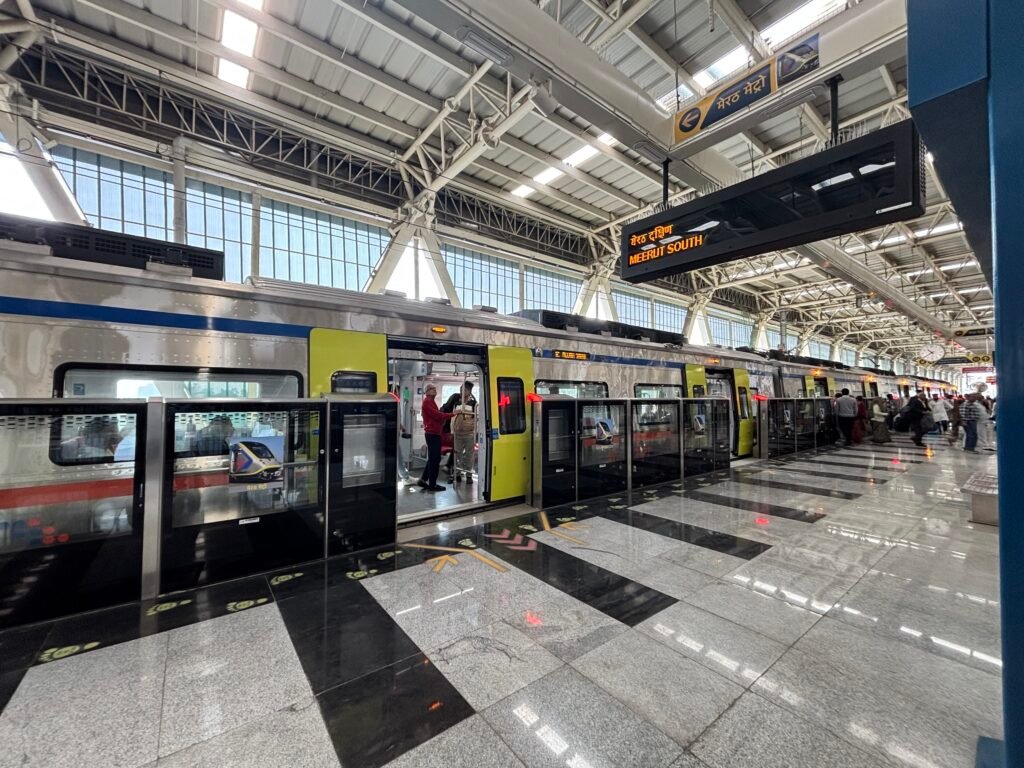
STN: The Gurugram–Faridabad Namo Bharat Corridor is set to improve travel across the National Capital Region (NCR). The Haryana Mass Rapid Transport Corporation (HMRTC) has proposed 18 metro stations along this route. This plan aims to make daily travel easier between Gurugram, Faridabad, and nearby areas.
The corridor will run for about 64 kilometres. Around 52 kilometres will be in Haryana, while the remaining 12 kilometres will extend into Uttar Pradesh. The route will connect key areas such as Noida and Greater Noida.
This project will combine Metro and Regional Rapid Transit System (RRTS) services. Both will run on the same track. This will help people travel faster and switch between systems without difficulty.
Integrated Metro Network on Gurugram–Faridabad Namo Bharat Corridor
The Gurugram–Faridabad Namo Bharat Corridor will include eight metro stations in Gurugram and ten in Faridabad. These stations will support both local and regional travel.
In Gurugram, the metro route will cover about 14.5 kilometres. It will start from Iffco Chowk and go up to Gwal Pahari. Important stations will include Sector 29, Millennium City Centre, Sector 52, Wazirabad, and Sector 57.
Iffco Chowk will act as a major interchange. It will connect this corridor with another planned route linking Delhi, Gurugram, and Shahjahanpur. Another key interchange is planned at Sector 61. This will connect to a future metro line between Sector 56 and Pachgaon.
The corridor will also connect with the Rapid Metro network. A station is planned between Sector 58 and Sector 61. The last stop in Gurugram will be at Gwal Pahari.
Faridabad Section of Gurugram–Faridabad Namo Bharat Corridor
After Gurugram, the corridor will move into Faridabad. The Faridabad section will have ten metro stations.
The first station will be at Sainik Colony. It will be followed by stations at NIT-3 and NIT-1. Bata Chowk will be an important interchange. It will connect with the Delhi Metro Violet Line, making travel to Delhi easier.
Other stations will be built near Sector 12-15 junction, Sector 80, and sectors 81-82, 85-86, and 88-89. The last metro station in Haryana will be at Badshahpur. After that, the corridor will continue towards Noida and Greater Noida.
High-Speed Travel and Better Planning
The Gurugram–Faridabad Namo Bharat Corridor will offer high-speed travel. Trains are expected to run at speeds between 160 kmph and 180 kmph. This will reduce travel time between cities.
To reduce noise in residential areas, officials plan to install noise barriers along parts of the route.
The project was discussed in a meeting held on February 24. The meeting was chaired by Haryana Chief Minister Nayab Singh Saini. Officials were asked to include metro station plans in the Detailed Project Report (DPR).
What This Project Means for NCR
This corridor will improve travel between Gurugram, Faridabad, and Noida. It will connect business areas, industrial zones, and residential sectors.
People will be able to travel faster and more easily. The project will also reduce traffic on roads. It will support better urban growth across the NCR.
FAQs
A: The project is still in the planning stage. A final timeline will be shared after DPR approval.
A: The cost has not been officially announced yet.
A: RRTS fares may be higher than metro fares, but final pricing is not confirmed.
A: Most major stations are expected to include parking, but details are awaited.
A: RRTS trains run at higher speeds and connect cities, while metro services are for shorter urban routes.