


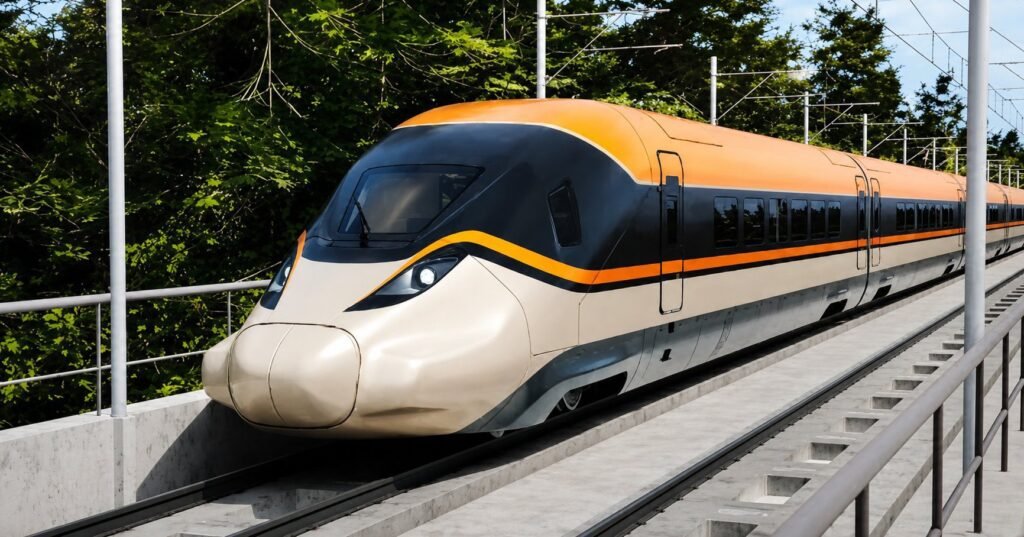
STN: India has taken a major step in high-speed rail development. State-owned BEML has unveiled the country’s first indigenous bullet train concept, named B28, in New Delhi. The announcement marks an important move in India’s plan to build advanced rail transport using domestic engineering and manufacturing.
The newly unveiled India indigenous Bullet Train concept has been designed for high-speed travel. The train can reach a top design speed of 280 km/h, while its operational speed will be 250 km/h. This puts it in line with many global high-speed train systems.
Officials plan to introduce the first trainset by 2027. The proposed deployment will happen on the Surat-Vapi stretch of the Mumbai-Ahmedabad High-Speed Rail corridor. This section covers around 97 kilometres and will play a key role in testing India’s high-speed rail readiness.
India Indigenous Bullet Train Designed for Speed and Comfort
The B28 train concept reflects India’s growing focus on building modern transport infrastructure with local expertise. BEML, known for manufacturing metro coaches and railway equipment, has now entered the high-speed rail segment.
Each B28 trainset will have eight coaches. Together, the train will accommodate 580 passengers. The design aims to balance speed, comfort, and passenger capacity.
The train concept also highlights India’s push for self-reliance in transport manufacturing. Until now, India’s bullet train ambitions have depended largely on international partnerships and imported technology. The B28 concept shows that domestic companies are preparing to take on larger roles.
Experts believe this project could help reduce dependence on foreign suppliers in the future. It may also create opportunities for Indian manufacturing, engineering jobs, and railway technology development.
India Indigenous Bullet Train to Support Future High-Speed Rail Growth
India’s high-speed rail plans have gained momentum over the past few years. The Mumbai-Ahmedabad High-Speed Rail project remains the country’s flagship bullet train initiative.
The addition of an indigenous concept train could support future corridor expansion. If the B28 performs well, India may consider similar trainsets for other planned high-speed routes.
High-speed trains can significantly cut travel time between cities. Faster connections can improve business travel, tourism, and regional development. This makes projects like the India indigenous Bullet Train important for long-term infrastructure growth.
The B28 concept also sends a strong signal about India’s engineering ambitions. Developing a bullet train locally involves advanced design, aerodynamics, safety systems, and manufacturing precision.
While the train concept has generated excitement, the actual rollout will depend on testing, approvals, and infrastructure readiness.
Why This Announcement Matters
This development matters because India is trying to build transport systems that match global standards while strengthening domestic manufacturing.
A successful indigenous bullet train can help India lower technology costs in the long run. It can also encourage local suppliers to enter the high-speed rail ecosystem.
For passengers, this could mean better travel options in the future. Faster trains can reduce travel stress and improve connectivity between growing economic hubs.
The B28 remains a concept for now, but it represents an important milestone in India’s railway journey.
FAQ
A: Yes, B28 is being presented as India’s first indigenous bullet train concept developed by BEML.
A: The train has a design speed of 280 km/h and an operational speed of 250 km/h.
A: Each eight-coach B28 trainset can seat 580 passengers.
A: The target rollout is 2027.
A: The Surat-Vapi stretch of the Mumbai-Ahmedabad High-Speed Rail corridor is the planned first route.
Additional Information
- The Mumbai-Ahmedabad bullet train project uses Japanese Shinkansen technology.
- High-speed rail systems need dedicated tracks and advanced signalling systems.
- BEML has prior experience in manufacturing metro coaches, defence vehicles, and rail equipment.
- India has proposed additional high-speed rail corridors in future infrastructure plans.