


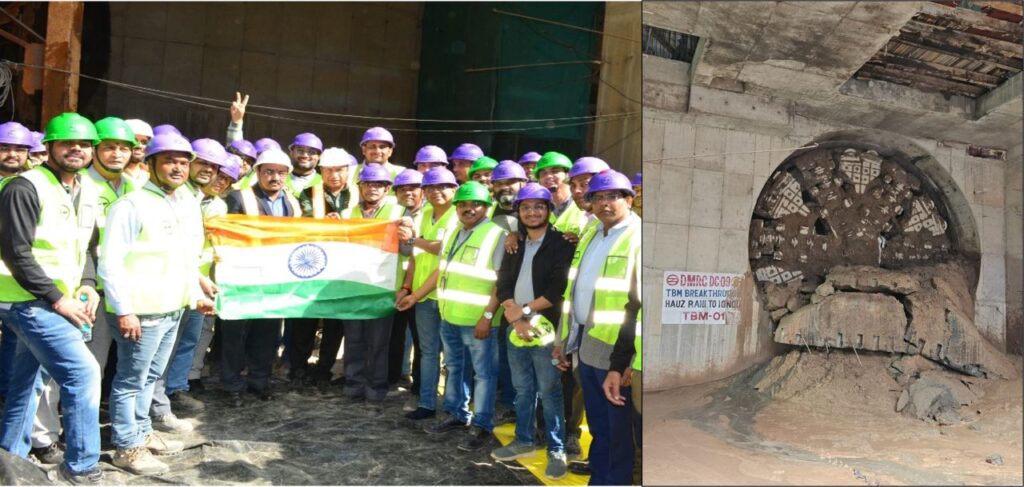
STN: L&T Construction has completed the entire tunnelling scope for the Delhi Metro Phase-IV Golden Line under the Delhi Metro DC-09 package. This corridor connects Aerocity to Tughlakabad and forms a key part of the capital’s expanding metro network.
The milestone was marked by the seventh and eighth Tunnel Boring Machine (TBM) breakthroughs at the IGNOU Station retrieval area. Senior officials from Delhi Metro Rail Corporation and L&T attended the event.
The completion of tunnelling under Delhi Metro DC-09 reflects months of planning, precision engineering, and round-the-clock work. The team delivered eight tunnel drives covering a total length of 10,650 metres. Engineers maintained strict safety standards throughout the process.
A First for Delhi Metro DC-09: Stacked Tunnelling at Neb Sarai
One of the most challenging aspects of Delhi Metro DC-09 was the execution of stacked tunnelling at Neb Sarai station. This was the first time both L&T and Delhi Metro Rail Corporation executed such a design.
The project team adopted this approach because the surface roads in the area are narrow. Engineers designed the station with two levels. Instead of laying tunnel tubes parallel to each other, they aligned them vertically.
This required vertically stacking two massive TBMs during tunnelling and even while driving through the station area. The team worked with a tight tolerance of just 100 mm. Any deviation could have affected the structure.
Engineers monitored ground movement and building stability at every stage. They used advanced surveying tools and real-time monitoring systems. The team coordinated closely to maintain accuracy.
Engineering Beneath a Dense Urban Zone
The Delhi Metro DC-09 project passed through densely populated areas. The team tunnelled beneath more than 650 multi-storey buildings. This required careful planning and constant monitoring.
Urban tunnelling presents several risks. Engineers must prevent settlement, vibration damage, and structural impact. The team adopted controlled excavation techniques. They ensured that daily life above ground continued without disruption.
The project also faced logistical challenges during the Graded Response Action Plan (GRAP) periods. These restrictions affected material movement and site operations. Despite this, the team maintained steady progress.
Safety remained a top priority. Workers followed strict protocols. Supervisors carried out regular inspections. The project met quality benchmarks set by Delhi Metro Rail Corporation.
Strengthening Connectivity in the Capital
The Aerocity–Tughlakabad corridor will improve connectivity across South Delhi. It will link residential zones, business districts, and transit hubs. The Golden Line will reduce travel time and road congestion.
The completion of tunnelling under Delhi Metro DC-09 moves the corridor closer to the next phase of construction. Track laying, station finishing, and system installation will follow.
L&T Construction thanked Delhi Metro Rail Corporation for its continued trust. The company stated that the milestone reflects its commitment to delivering complex urban infrastructure projects.
The successful execution of stacked tunnelling sets a new benchmark. It demonstrates India’s growing expertise in advanced metro engineering.
As Delhi expands, projects like Delhi Metro DC-09 play a critical role in building reliable public transport. The Golden Line will support daily commuters and future urban growth.
FAQs
A: The team completed 10,650 metres of tunnelling across eight TBM drives.
A: In stacked tunnelling, engineers place tunnel tubes vertically instead of side by side. This method helps when surface space is limited.
A: Narrow roads and space constraints led engineers to adopt a two-level station design.
A: Engineers used ground monitoring systems, controlled excavation methods, and precision surveying tools.
A: Authorities will proceed with track installation, station construction, and system integration before the corridor becomes operational.