


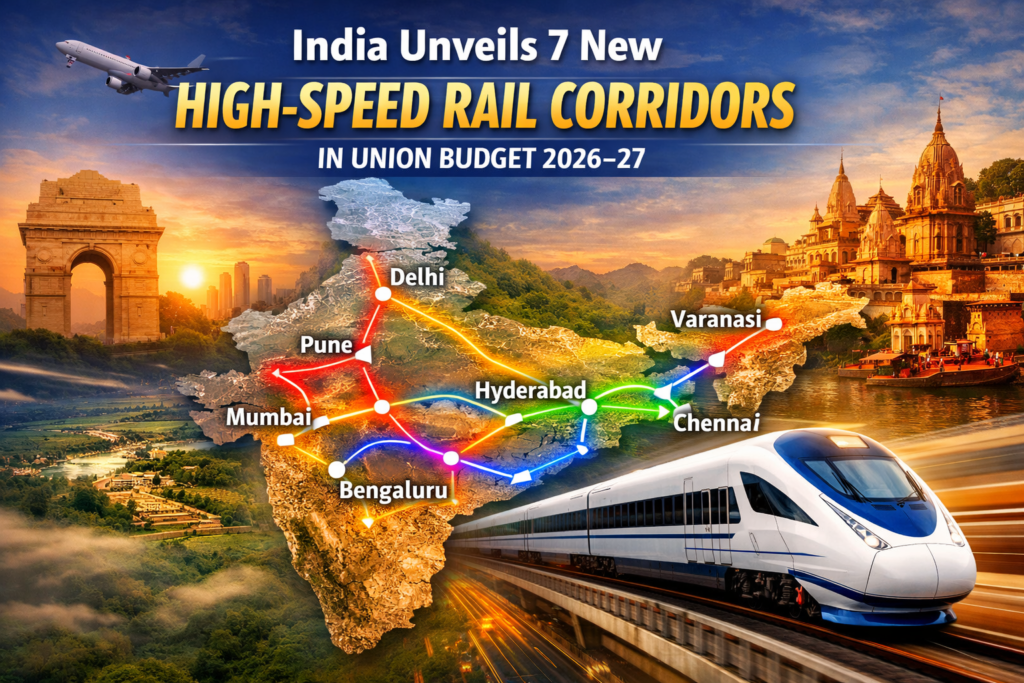
STN: India is stepping into a new era of rail travel. The Government of India announced seven new high-speed rail corridors in India under the Union Budget 2026–27. These corridors will connect major cities across the country. The move marks one of the boldest infrastructure decisions in recent railway history.
The announcement signals a clear shift in how India plans to move its people. Fast, efficient, and modern, this is the future the government is building.
Seven New High-Speed Rail Corridors in India — The Full List
The seven newly announced corridors cover the length and breadth of the nation:
- Mumbai–Pune — connecting Maharashtra’s two biggest cities
- Pune–Hyderabad — linking the Deccan Plateau’s key urban centres
- Hyderabad–Bengaluru — bridging two of India’s fastest-growing tech hubs
- Hyderabad–Chennai — connecting the south’s two major capitals
- Chennai–Bengaluru — two IT powerhouses linked at high speed
- Delhi–Varanasi — a historic route connecting the capital to a cultural heartland
- Varanasi–Siliguri — stretching into eastern India for the first time
Together, these routes create a web of fast connectivity across the South, West, and North-East of India.
Why These High-Speed Rail Corridors in India Matter
India’s rail network is one of the largest in the world. But speed has always been a challenge. Most trains on the existing network run at 100–130 km/h. High-speed rail changes that entirely.
These corridors will run at speeds of 250 km/h or more. A journey that takes six hours today could take under two hours tomorrow.
The economic impact is massive. Faster travel means more business connections. It means workers can commute between cities. It means tourists can see more of India in less time.
The southern network alone — covering Hyderabad, Bengaluru, and Chennai — connects three of India’s top five IT cities. This triangle drives a significant portion of India’s tech economy. High-speed links between them will accelerate growth even further.
The Delhi–Varanasi corridor is equally significant. It connects the political capital to one of India’s oldest living cities. It will bring pilgrims, tourists, and businesses closer than ever before.
The Varanasi–Siliguri route extends that reach eastward. It connects the Ganga plains to the foothills of the Himalayas. This is a region that has historically lacked fast connectivity.
High-Speed Rail Corridors in India — Building on the Mumbai-Ahmedabad Model
India already has one high-speed rail project under construction. The Mumbai–Ahmedabad bullet train corridor has been in progress since 2017. It uses Japanese Shinkansen technology. The new seven corridors build on lessons from that project.
The government appears ready to scale up rapidly. Announcing seven corridors at once shows serious commitment. It tells investors, engineers, and citizens that this is not a one-off project. It is a national programme.
Indian Railways has been evolving steadily. The Vande Bharat Express brought semi-high-speed travel to millions. Now, full high-speed rail takes that vision further.
What Comes Next
The corridors are announced. Detailed project reports, land acquisition, and contractor selection will follow. These processes take time. But the direction is clear.
India is building for speed. It is building for scale. And with seven new high-speed rail corridors in India now on the map, the country’s rail revolution is well and truly underway.
FAQ
A: High-speed rail trains typically operate at 250–350 km/h. India’s existing bullet train project targets speeds of 320 km/h using Shinkansen technology.
A: Ticket pricing has not been announced yet. Fares are generally higher than regular trains but lower than air travel, depending on the corridor and class.
A: The government has not confirmed the technology vendor for all seven corridors. The Mumbai–Ahmedabad project uses Japanese Shinkansen tech. Future projects may use European, Chinese, or homegrown Indian technology.
A: No official timeline has been released yet. Large rail infrastructure projects of this scale typically take 7–15 years from announcement to operation.
A: True high-speed rail requires fully dedicated, elevated tracks. Sharing tracks with slower trains is not feasible at speeds above 200 km/h. New dedicated infrastructure will need to be built.
A: Funding details are not yet public. India has used a mix of sovereign loans, public investment, and PPP (public-private partnership) models for major rail projects in the past.
A: Yes, significantly. For distances of 500–800 km, high-speed rail typically competes directly with domestic flights. Travel time becomes comparable, but rail is generally more convenient for city-to-city journeys.