


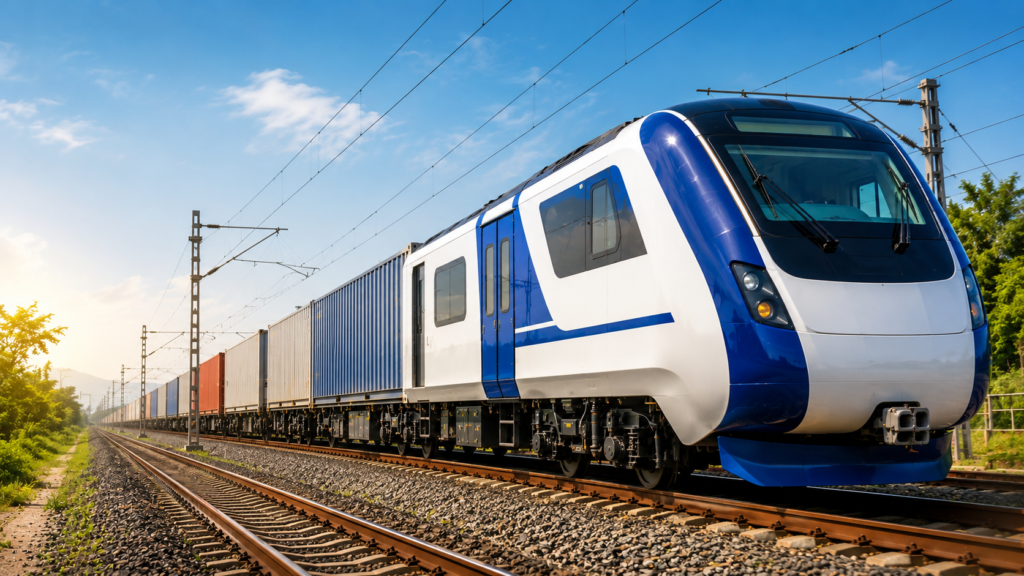
STN: India has taken another major step towards modernising its railway freight network. The country’s first Vande Bharat Freight Train has officially entered trial runs on the busy Delhi–Mumbai rail corridor. During the trial, the train achieved a top speed of 145 kmph, marking a significant milestone in India’s efforts to develop faster and more efficient cargo transportation.
The new freight service is expected to transform the movement of high-value parcels, e-commerce shipments, and temperature-sensitive goods. Unlike conventional freight trains, the Vande Bharat Freight Train has been designed to deliver cargo quickly while maintaining reliability and efficiency.
The trial also highlights Indian Railways’ broader strategy of introducing advanced rolling stock that can improve logistics across the country.
Vande Bharat Freight Train Designed for High-Speed Cargo
The Vande Bharat Freight Train is a 16-wagon Electric Multiple Unit (EMU) specially developed for parcel transportation. Unlike traditional freight trains that are hauled by a locomotive, an EMU has powered coaches that provide faster acceleration and better operational efficiency.
The train has been built to carry light but high-value cargo. This includes e-commerce consignments, courier shipments, electronics, pharmaceuticals, fresh produce, and other products that require quick delivery.
The Delhi–Mumbai rail corridor was selected for the initial trial because it is one of India’s busiest freight and passenger routes. Successful trials on this corridor could pave the way for operations on several other high-demand routes across the country.
Rail experts believe the new freight service could bridge the gap between road transport and air cargo. It offers faster transit than conventional freight trains while remaining more affordable than air freight.
How the Vande Bharat Freight Train Will Benefit Logistics
The biggest advantage of the Vande Bharat Freight Train is speed. Conventional freight trains often share tracks with passenger services and operate at lower average speeds. The new EMU-based freight train is designed to reduce transit times considerably.
Faster transportation means businesses can maintain lower inventories while ensuring quicker deliveries to customers. This is especially valuable for online retailers, courier companies, pharmaceutical manufacturers, and food businesses.
The train is also expected to support India’s rapidly growing e-commerce market. Online shopping continues to expand across the country, increasing demand for dependable and time-bound logistics services.
Another important benefit is the transportation of temperature-sensitive products. Medicines, vaccines, dairy products, flowers, fruits, vegetables, and other perishables require faster movement to preserve quality. Reduced travel time can help minimise spoilage and improve supply chain efficiency.
In addition, faster rail-based cargo movement could encourage companies to shift freight from roads to rail. This may help reduce highway congestion, lower fuel consumption, and decrease carbon emissions over time.
Trial Marks a New Phase for Indian Railways
The trial run represents an important milestone for Indian Railways as it expands the successful Vande Bharat platform beyond passenger services.
Over the past few years, Vande Bharat trains have become known for their higher speeds, improved comfort, and modern technology. Applying similar engineering principles to freight transportation could create a new category of premium cargo services in India.
Officials will now evaluate the train’s performance during multiple trial runs. They will assess speed, braking systems, operational reliability, safety standards, and overall efficiency before commercial operations begin.
If the trials are successful, similar high-speed freight trains may be introduced on additional corridors connecting major industrial centres, ports, logistics hubs, and metropolitan cities.
The initiative also supports the government’s focus on improving multimodal logistics and strengthening the country’s supply chain infrastructure. Faster rail cargo services can help businesses reduce transportation costs while improving delivery timelines.
The successful deployment of the Vande Bharat Freight Train could become a game-changer for India’s logistics sector. As industries increasingly demand faster and more reliable transportation, high-speed freight trains have the potential to redefine cargo movement across the nation.
Frequently Asked Questions (FAQs)
A: The Vande Bharat Freight Train is India’s first high-speed freight Electric Multiple Unit (EMU) designed to transport parcels, e-commerce shipments, and other high-value cargo.
A: During its trial run on the Delhi–Mumbai rail corridor, the train reached a top speed of 145 kmph.
A: It is expected to transport e-commerce parcels, courier consignments, pharmaceuticals, electronics, fresh produce, dairy products, flowers, and other temperature-sensitive or high-value goods.
A: It can significantly reduce cargo transit times, improve logistics efficiency, support e-commerce growth, and encourage a shift from road transport to rail.
A: Commercial services are expected to start after Indian Railways successfully completes all technical and safety trials. An official launch date has not yet been announced.