


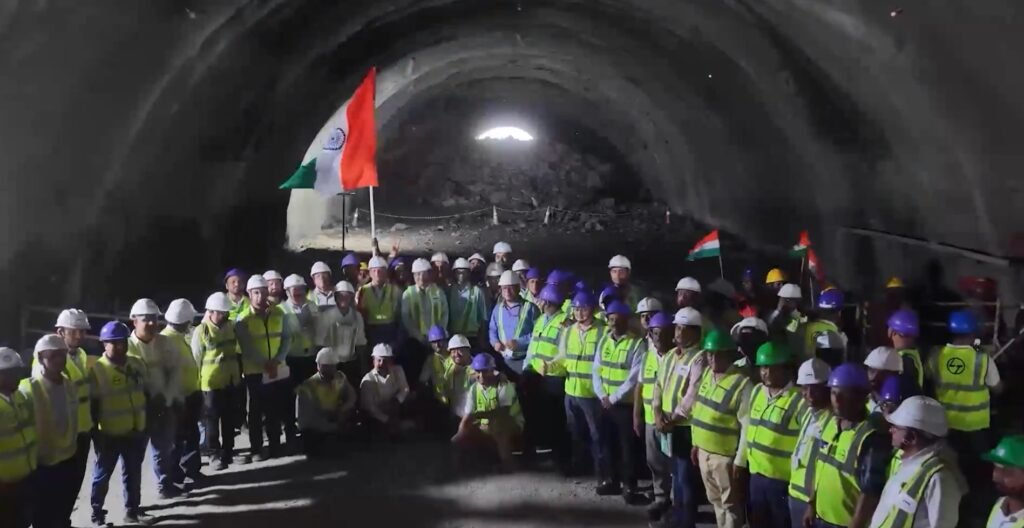
STN: The Mumbai-Ahmedabad Bullet Train Project has achieved another important milestone in Maharashtra. Union Railway Minister Ashwini Vaishnaw recently shared that the third mountain tunnel breakthrough has been completed within just five months in Dahanu Taluka of Palghar district.
The update marks steady progress in India’s first high-speed rail corridor. The tunnel breakthrough is seen as a major engineering achievement for the ambitious rail project connecting Mumbai and Ahmedabad.
Mumbai-Ahmedabad Bullet Train Project Crosses Another Engineering Milestone
The newly completed tunnel breakthrough took place in the mountainous region of Dahanu in Maharashtra. Tunnel construction is considered one of the toughest parts of the entire high-speed rail corridor. Engineers and workers had to cut through difficult rock formations and challenging terrain.
Completing three mountain tunnel breakthroughs within five months shows the fast pace of work on the project. It also reflects the growing momentum of India’s bullet train infrastructure development.
The Mumbai-Ahmedabad Bullet Train Project is being developed using Japanese Shinkansen technology. The corridor aims to reduce travel time between Mumbai and Ahmedabad from nearly seven hours to around two hours.
Officials believe the project will transform intercity travel in western India. Faster travel will improve business connectivity, tourism, and economic growth across Maharashtra and Gujarat.
Mumbai-Ahmedabad Bullet Train Project Expected to Boost Regional Development
The high-speed rail corridor is expected to bring major benefits to several regions along the route. Construction activities are already generating jobs and supporting local businesses.
The project passes through key locations in Maharashtra and Gujarat. It includes multiple stations, bridges, tunnels, and elevated corridors. One of the biggest engineering highlights is the undersea tunnel section near Mumbai.
The National High Speed Rail Corporation Limited (NHSRCL) is overseeing the project. Large portions of viaduct construction and pier work have already been completed in Gujarat and Maharashtra.
According to officials, advanced Japanese technology and modern safety systems will make the bullet train one of the safest and fastest transport systems in India.
The latest tunnel breakthrough in Palghar district also highlights the growing capabilities of Indian engineers and construction teams working on complex infrastructure projects.
Fast Progress Raises Hope for Timely Completion
The Mumbai-Ahmedabad Bullet Train Project has faced several delays in the past due to land acquisition and environmental clearances. However, recent construction updates indicate that work is now moving at a faster pace.
Several station buildings are under construction. Track laying activities have also started in parts of Gujarat. Officials continue to monitor the progress closely to meet future operational targets.
The bullet train corridor is expected to improve passenger convenience and reduce pressure on existing railway and highway networks.
Experts believe the project could also encourage future high-speed rail corridors in other parts of India.
FAQ
A: It is India’s first high-speed rail corridor connecting Mumbai in Maharashtra with Ahmedabad in Gujarat using Japanese Shinkansen technology.
A: The latest tunnel breakthrough was completed in Dahanu Taluka of Palghar district in Maharashtra.
A: Tunnel construction helps the rail corridor pass through mountainous and difficult terrain safely and efficiently.
A: The bullet train is expected to reduce travel time between Mumbai and Ahmedabad to around two hours.
A: The project is being implemented by the National High Speed Rail Corporation Limited (NHSRCL).
Additional Facts
- The bullet train will operate at a speed of up to 320 kmph.
- The corridor length is approximately 508 km.
- The project includes 12 stations between Mumbai and Ahmedabad.
- Japan is providing financial and technical support for the project.
- Special earthquake-resistant technology is being used for safety.